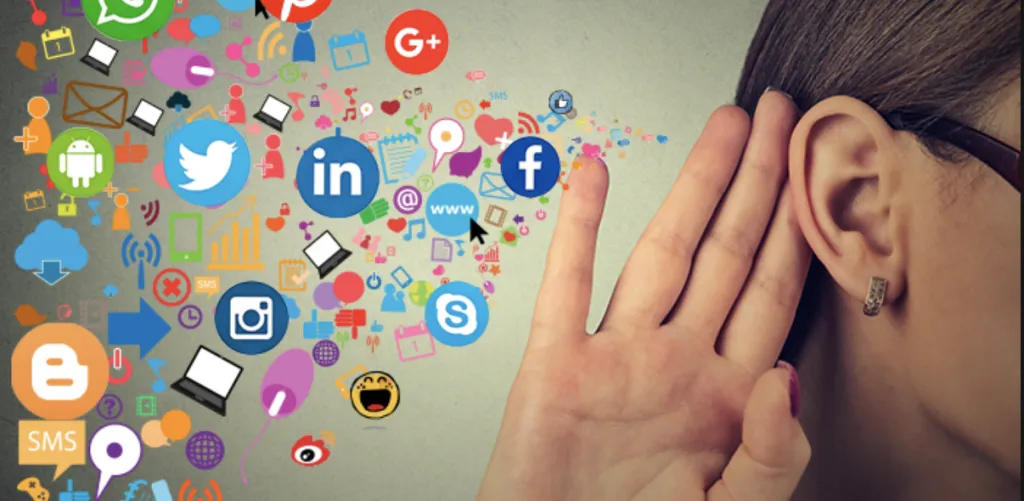
Every day, people online talk about brands, products, and services without always tagging the official accounts. They share experiences, ask questions, report problems, compare offers, or express needs in posts, videos, comments, or public conversations.
These exchanges are a valuable source of information. Yet many companies still limit themselves to the notifications on their own accounts. They see direct mentions but miss conversations where their name isn't properly tagged, misspellings, indirect mentions, and emerging trends.
Social listening, also known as social monitoring, lets you track these discussions, analyze them, and turn them into actionable decisions. It’s not just about tallying positive and negative comments. A genuine listening approach helps you understand your audience, improve your content, detect a crisis, and spot new opportunities.
Social listening involves searching for and analyzing public conversations about a brand, product, industry, competitor, or specific topic on social media and other digital platforms.
This monitoring can cover:
The goal isn't to collect as many messages as possible without using them. You need to identify the important conversations, understand what they reveal, and decide what actions to take.
Monitoring and social listening are complementary, but they don't correspond to exactly the same level of analysis.
| Approach | Primary objective | Example |
|---|---|---|
| Social monitoring | Spot messages that require a response | Responding to a customer reporting a delay |
| Social listening | Understand the trends and the drivers behind conversations | Discover that delays have become a recurring problem |
| Performance analysis | Measure the results of your own content | Compare the reach and engagement of posts |
Monitoring answers the question: 'What just happened?'
Social listening aims more to understand: "Why is this happening and what should we change?"
To complete this approach with a structured analysis of your own accounts, consult the method for carrying out a complete audit of your social media.
Consumers no longer automatically contact a company when they want to express an opinion. They may post a video, reply under a creator's content, take part in a group conversation, or ask their community for advice.
A brand that limits itself to its inbox therefore only sees part of what's being said about it.
Spontaneous conversations often use a more natural vocabulary than responses collected in a questionnaire. They reveal needs, frustrations, and decision criteria expressed in the consumers' own words.
These phrasings can then improve:
A company can thus tailor its messaging to the concerns actually expressed by its audience.
An unusual rise in negative comments can indicate a delivery issue, a breakdown, a pricing misunderstanding, or a misinterpreted campaign.
If detected quickly, the problem can be addressed before it becomes a public crisis.
In particular, the brand should monitor:
If the situation worsens, use a real social media crisis management plan to organize responses, approvals, and official communication.
Repeated questions often make the best topics for posts.
If multiple people ask how to choose a product, solve a problem, or avoid a mistake, the brand already has a topic validated by its audience.
A common question can become:
These signals can feed a content ideas library and reduce reliance on ad hoc brainstorming sessions.
Social listening also lets you study conversations about competitors.
The goal is not to replicate their strategy, but to identify:
This information can help a company clarify its positioning and improve its offering.
Effective monitoring shouldn't be limited to the exact brand name. Internet users may misspell it, use an abbreviation, or mention only a product.
Build your list around several categories of requests.
Watch for:
Associate the brand or product name with terms such as:
These associations help detect conversations that match a specific intent.
Also monitor the phrases used by someone facing a problem who doesn't yet know about your solution.
A social media scheduling platform can, for example, detect phrases like:
These conversations reveal people expressing a need before they even mention a brand.
Relevant conversations aren't all in the same place. The channels to monitor depend on the activity and the target audience.
It's better to monitor three spaces your customers actually use than ten platforms without a strategy.
A good strategy can be implemented gradually.
Start by choosing what you want to learn. A goal that's too broad produces a lot of data that's hard to analyze.
You may want to:
Each objective requires different keywords, sources, and metrics.
Group keywords by theme:
Gradually remove terms that return too many results unrelated to your business.
A simple classification turns a stream of messages into actionable insights.
| Category | Example | Possible action |
|---|---|---|
| Question | How to use the product? | Respond and create a tutorial |
| Dissatisfaction | The service seems too complicated | Contact the customer and analyze their journey |
| Positive feedback | The product saved me time | Thank and request permission to share |
| Comparison | Which solution should you choose between two brands? | Clarify the positioning |
| Trending | A question suddenly resurfaces | Quickly create relevant content |
| Risk | Several complaints appear | Alert the relevant teams |
| Opportunity | A user is looking for a solution | Provide a helpful, personalized response |
Each type of alert should be sent to the right person.
A simple question can be handled by the community manager, while a payment issue should be forwarded to customer support. A serious accusation sometimes requires legal or managerial approval.
A clear workflow can be organized like this:
This setup prevents an important message from going unanswered.
Daily monitoring is for quick responses. Weekly or monthly summaries are for understanding trends.
The report may include:
The goal remains to produce a readable summary, not a document full of statistics with no conclusion.
Sentiment analysis typically classifies messages into three groups:
This breakdown provides an initial indication, but should be interpreted with caution.
Humor, sarcasm, local expressions and context can mislead automated analysis. A sentence like "Great, another outage" contains a positive word while clearly expressing criticism.
For important conversations, keep human validation. Also analyze the topic and intensity of the message.
Ten reviews highlighting a specific flaw can be more significant than a hundred very general positive reactions.
Indicators must remain linked to the initial objective.
You can measure, for example:
The engagement rate of your own posts is also useful for measuring your community's reaction. Discover how to calculate your engagement rate on social media and interpret the results.
Social listening only becomes truly valuable when the information gathered improves the editorial strategy.
Here are some possible transformations:
| Signal detected | Content to create |
|---|---|
| A recurring question | Tutorial or carousel |
| A misunderstanding | Explanatory post |
| A sales objection | Demo or case study |
| A positive review | Customer testimonial |
| An emerging trend | Analysis post |
| A common comparison | Selection guide |
| A usability issue | Step-by-step video |
Positive feedback can fuel a social proof post, provided you obtain the necessary permissions. Find out how to transform them customer reviews as social media content.
A sales objection can also become content that directly provides a complete answer. This approach is detailed in the guide dedicated to the zero-click content strategy.
Not every mention requires intervention. A systematic response can feel intrusive, especially when a user is talking with their friends and not addressing the brand.
It's generally appropriate to respond when someone:
Sometimes it's better to observe when:
The best answer is not always the quickest. It must be useful, accurate, and appropriate to the context.
This method ignores mistakes, product names, abbreviations, and conversations expressing a need without naming the company.
A report full of charts is useless if no team turns the insights into concrete improvements.
A single negative comment does not necessarily constitute a PR crisis. Assess its reach, credibility, and sharing dynamics before triggering a disproportionate response.
Automation makes collection and sorting easier, but it doesn't always capture nuances. The strategy should retain human validation, as with any process...Social media automation.
The fact that content is publicly accessible does not authorize all uses. Avoid creating intrusive profiles, limit collection to necessary information, and comply with platform terms and applicable regulations.
A small business can start without setting up a complex organization.
The identified topics can then be organized into a 30-day editorial calendar, then prepared and scheduled from a centralized platform.
Social listening reveals what truly interests your audience. You then need to turn that information into coherent posts and publish them at the right time.
AuraPost helps organize the operational phase by allowing you to prepare and schedule social media content.
A brand can therefore:
Discover the features of AuraPost and consult the available plans to choose the organization that meets your needs.
No. A small business (TPE) can monitor a limited number of keywords and focus on the two or three platforms most important to its customers.
You can start with internal search, notifications, alerts and manual organization. A specialized solution becomes useful when volume grows or multiple brands need to be monitored.
Prioritize monitoring the platforms where your customers actually speak. A B2B brand may favor LinkedIn, while a consumer brand may focus on Instagram, TikTok, Facebook, or YouTube.
Don’t limit yourself to the number of positive mentions. Analyze their trends, the topics discussed, the reach of conversations, recurring criticisms, and the company’s ability to resolve issues.
Yes—when someone publicly expresses a need that matches your solution. The approach should remain helpful and personalized, however. An overly commercial response can damage the brand's reputation.
Important alerts should be checked daily. A more comprehensive analysis can be done weekly, then included in a monthly report.
Social listening turns public conversations into actionable insights. It helps you understand customer expectations, spot problems, identify trends, and find content topics already validated by your audience.
To get results, a brand must go beyond merely collecting mentions. It must set goals, monitor the right terms, classify conversations, send alerts to the appropriate teams, and integrate the insights into its strategy.
Social listening then becomes a continuous cycle:
By combining this approach with a comprehensive social media strategy and with a solid editorial organization, the company publishes more relevant content and builds a closer relationship with its audience.

